| ADVOCACY AND ACTION
August 24, 2026
| Published by LWVAZ Advocacy Committee to update members on news and calls to action.
Editors: Gitelle Seer, Pinny Sheoran | Now Is a Time for Action: Protecting the Vote, Empowering Voters | |
August reminds us that voting rights have never been self-sustaining. They have been secured, protected, and strengthened because generations of Americans were willing to stand up, speak out, organize, and act.
This month, we commemorated the 61st anniversary of the Voting Rights Act of 1965 by creating two powerful community conversations: Listening Circles that elevated the voices and lived experiences of Latino and Native American voters.
What we heard matters.
Community members shared compelling stories about barriers to voting, the continuing importance of the Voting Rights Act, and what equal access to the ballot means to their families and communities. We urge you to listen, as we did, to these voices and experiences.
But listening is only the beginning.
We encourage our local Leagues and members to create opportunities for listening in their own communities. Gather people who care about voting rights. Invite Native and Latino neighbors and trusted community partners to share their experiences. Most importantly, listen and help elevate the voices of those whose access to our democracy has too often been diminished or ignored.
Now We Must Prepare for the General Election
As we move toward the General Election, every League member has an opportunity to participate. Our work is not about helping a party or candidate win. Our work is about voters: helping eligible voters participate, providing trustworthy nonpartisan information, protecting access to the ballot, and helping ensure that every lawful vote is counted.
There are many ways to help.
Register Voters
September is National Voter Registration Month, with National Voter Registration Day on September 22.
Local Leagues across Arizona will have opportunities to register voters at high schools, colleges, naturalization ceremonies, community events, and other locations.
We especially want to reach newly eligible voters, newly naturalized citizens, young voters, and communities that historically experience barriers to participation.
Watch for volunteer opportunities from your local League and LWV of Arizona, and please sign up.
Get Out the Vote
We know that elections can be decided by remarkably small margins. Every eligible voter should have the opportunity and information needed to make their own voice heard.
Our Get Out the Vote work will require many hands.
We need volunteers to help develop voter messaging, recruit and organize volunteers, text voters, make phone calls, participate in canvassing and community outreach, and connect voters with reliable election information.
Whether you can help plan an entire campaign or give us a few hours to contact voters, there is a place for you in this work.
Empower Voters Through VOTE411
One of the most valuable contributions every League member can make is to amplify VOTE411.org, the League's trusted, nonpartisan voter information resource.
VOTE411 provides voters with information about candidates, ballot measures, voting rules, polling locations, and other essential election information. Candidate questionnaires give candidates an opportunity to speak directly to voters by answering questions on issues important to their communities. Armed with reliable, nonpartisan information, voters can then communicate their support or opposition through the most powerful voice they have - their informed vote.
We will need volunteers to help contact candidates, encourage their participation, promote VOTE411 throughout Arizona, and deliver nonpartisan presentations on ballot measures.
Share VOTE411 with your family, friends, neighbors, community organizations, and networks. Help voters find the information they need to make their own informed decisions.
Protect the Vote
LWV of Arizona is part of the Election Protection Coalition, and we are preparing for another critical election season.
We need coordinators and volunteers who can help voters experiencing problems and report concerns through established Election Protection channels.
Election Protection volunteers can help identify and report problems involving voter access, intimidation, misinformation, inappropriate interference at voting locations, or other barriers that may prevent eligible voters from casting their ballots.
Our role is important: observe, document, report, and help connect voters with appropriate assistance.
Become a Poll Worker
There is another extraordinarily important way to protect our elections: help administer them. Arizona counties are recruiting poll workers now.
League members can serve during early voting and on Election Day, at vote centers and polling locations, and in other election-support roles for which counties recruit and train workers.
Election administration depends upon thousands of ordinary citizens willing to step forward and do this work. Please consider being one of them.
Be Ready to Defend the Democratic Process
Our responsibility does not end when the polls close.
The period between Election Day and certification is also an important part of the democratic process. League members should remain attentive to credible reports of voter suppression, intimidation, interference with election administration, or attempts to improperly prevent lawful votes from being counted or certified.
When concerns arise, we must respond responsibly: document what we know, distinguish verified information from rumors, report incidents through appropriate channels, and rely on established election officials and Election Protection resources.
The League will continue to monitor developments across Arizona and, when warranted and consistent with our mission, respond through voter education, public advocacy, coalition work, and legal action.
This Is Our Moment
There is a danger in believing that protecting democracy is someone else's responsibility.
It isn't.
For more than a century, the League of Women Voters has fought to expand voting rights, defend democracy, and empower voters. That commitment is as strong as ever.
There are opportunities for all of us.
- Register voters.
- Get out the vote.
- Empower voters with trustworthy information.
- Protect access to the ballot.
- Serve as a poll worker.
- Listen to communities whose voices need to be heard.
- Stand ready to defend a free, fair, accessible, and transparent election.
There are opportunities for all of us.
Democracy requires more than belief. It requires participation.
Now through Election Day and beyond, let us answer that call.
Pinny Sheoran
State Advocacy Chair
Gitelle Seer
Advocacy Vice Chair
League of Women Voters of Arizona
Email us at LWVAZADVOCACY@gmail.com
|
2026 Elections Calendar
|
Sept. 19
|
UOCAVA (Military and Overseas) ballots mailed
|
|
Oct. 5
|
Last day to register to vote
|
|
Oct. 7
|
Early voting begins
|
|
Oct. 7
|
Early ballots mailed to voters on AEVL (Active Early Voting List) and voter who requested a one-time ballot by mail
|
|
Oct. 23
|
Last day to request a ballot by mail if not on AEVL
|
|
Oct. 27
|
Recommended last day to return your ballot by mail
|
|
Oct. 30
|
Last day to vote early in person
|
|
Nov. 3
|
General Election
|
|
Nov. 8
|
Last day ID verification for conditional and provisional ballots & curing early ballot signatures
|
|
Nov. 19
|
Deadline for BOS canvass (county and school board races)
|
|
Nov. 8
|
Last day ID verification for conditional and provisional ballots & curing early ballot signatures
|
|
Nov. 23
|
Official State canvas
|
| | Arizona State Ballot Propositions: Help Voters Understand the Real Impact
The analysis is nearly complete. Now we need League members across Arizona to help us get this information into the hands of voters.
LWVAZ is preparing neutral, nonpartisan information on all eight statewide propositions that voters will see on the November 2026 ballot. The same core analysis will be used across our voter-education efforts, including VOTE411, printed ballot-measure materials, and League community presentations.
Our Next Step: Educate and Share
We are no longer seeking volunteers to assist with the analysis. Instead, we are asking members and local Leagues to help us promote and distribute these voter-education resources throughout their communities.
Our printed ballot-measure materials will be available in English and Spanish, with an anticipated availability date of September 7. We are also preparing a statewide presentation slide deck and presenter guidance for local Leagues conducting ballot-measure education programs.
Once the materials are available, members can help by:
-
Promoting VOTE411 through social media, newsletters, community networks, and partner organizations.
-
Distributing LWVAZ's printed ballot-measure materials at community events, libraries, meetings, voter-registration activities, and other appropriate locations.
-
Sharing the digital ballot information with friends, family, community organizations, and partner networks.
-
Encouraging voters to use VOTE411 to learn about the propositions and other races and issues on their ballot.
-
Helping connect LWVAZ and local Leagues with organizations and community events where these nonpartisan voter-education materials can reach additional voters.
Our goal is simple: give Arizona voters reliable, understandable, nonpartisan information so they can make their own informed decisions at the ballot box.
Eight Statewide Propositions on the November 2026 Ballot
Ballot measures approved by Arizona voters can be difficult to change. Constitutional amendments can be changed only through another vote of the people, while voter-approved laws receive protections under Arizona’s Voter Protection Act, which limits the Legislature’s ability to repeal or amend them.
This year, there are no citizen initiatives on the statewide ballot. All eight statewide propositions were referred to voters by the Arizona Legislature. That distinction matters.
Citizen initiatives allow Arizonans to propose laws or constitutional amendments directly when they believe the Legislature has not addressed an issue or when they seek to change existing law. Getting a citizen initiative onto the ballot, however, requires an extensive and costly process, including drafting the measure, statewide organizing, raising funds, gathering and validating hundreds of thousands of signatures, and often defending the measure against legal challenges.
A legislative referral has a very different path. The Legislature can place a measure before voters by securing approval from the required majority in both the House and Senate, without collecting voter signatures.
In recent election cycles, citizen-led ballot measures have also faced significant legislative and legal challenges before reaching voters. The absence of citizen initiatives from this year’s statewide ballot, alongside eight legislative referrals, highlights the significant hurdles citizens must overcome to put a question before Arizona voters.
As part of our advocacy work, LWVAZ submitted arguments for inclusion in the Arizona Secretary of State’s publicity pamphlet on ballot propositions for which the League has public policy positions. Several measures for which we submitted arguments ultimately did not make the ballot.
Of the propositions that made it to the ballot, the League submitted arguments against Propositions 142, 144, 318, and 320. Since we have no position on the remaining propositions, we did not submit an argument. Read LWVAZ’s Final Arguments Submitted to the Secretary of State.
|
Key:
100 = Legislative referral, constitutional amendment (3 measures)
200 = Citizens' Initiative (none on the ballot)
300 = Legislative referral, statutory amendment (5 measures)
Proposition 141 — Legislative Referral (SCR1004, 2025)
Prohibits taxes or fees based on vehicle miles traveled and laws monitoring or limiting vehicle miles traveled without consent.
Proposition 142 — Legislative Referral (HCR2044)
Adds details to the constitutional prohibition against preferential treatment or discrimination by the state based on race, ethnicity, or other classes.
Proposition 144 — Legislative Referral (HCR2001)
Requires government-issued identification for all voters, including voters by mail, and makes other election-administration and campaign-finance changes.
Proposition 316 — Legislative Referral (HCR2021, 2025)
Retroactively prohibits local governments from adopting or increasing a grocery tax without voter approval and sets a maximum rate of 2%.
Proposition 317 — Legislative Referral (HCR2055, 2025)
Declares drug cartels terrorist organizations and directs the Arizona Department of Homeland Security to address cartel threats.
Proposition 318 — Legislative Referral (HCR2003)
Requires schools and athletic associations to designate teams based on biological sex as recorded at birth and restricts use of private spaces.
Proposition 319 — Legislative Referral (SCR1004)
Restricts state and local use of photo-enforcement systems and requires local voter approval for continued use.
Proposition 320 — Legislative Referral (SCR1032)
Requires specified school districts to spend at least 60% of operational spending on direct instructional expenses and reduces certain funding for noncompliance.
|
Watch for the League's statewide ballot measure booklets, which will be ready around September 7, and help distribute them in our communities. Every member can play a role in helping Arizona voters find trusted, nonpartisan election information.
| |

VOTE411 — Something Big Is Coming Your Way!
VOTE411, the League of Women Voters’ trusted, nonpartisan online Voters’ Guide, will be published on October 7, coinciding with the start of early voting.
Explore Your Personalized Ballot
Go to VOTE411.org and enter your address to see the races, candidates, and ballot propositions that will appear on your November ballot. You can:
-
Read candidates’ responses to League questions.
-
Learn about state ballot propositions.
-
Find reliable information about when, where, and how to vote.
-
Create your own personalized ballot.
As you review each race, put a checkmark next to the candidate you plan to vote for. When you are finished, return to your list of races and click Finish in the upper-left corner of the blue bar. You can then print, email, or text your selections, making it easy to take your choices with you and share VOTE411 with friends and family.
Candidates may continue to respond, update, or edit their information through November 3, so check back for new responses.
What Can I Do to Help? So Glad You Asked! You can make a difference!
Help Us Encourage Candidates to Respond.
-
We invited all candidates on the ballot for whom we could verify contact information to participate in VOTE411. Despite repeated invitations and reminders, not every candidate responds.
-
Go to VOTE411.org, enter your address, and see whether the candidates in your races have answered our questions.
-
If a candidate responded, thank them! Use the contact information in the candidate's VOTE411 profile. For example:
-
If a candidate has not responded, encourage them to participate. For example:
-
We also need League members to contact unresponsive candidates across Arizona. We will provide candidate contact information and simple instructions.
-
Please be respectful but direct. Candidates need to know that voters value the opportunity to hear from them directly.
-
Even a few calls or emails can help. When candidates hear directly from voters who want to see their responses, they have another reason to participate.
-
To volunteer, email lwvazadvocacy@gmail.com.
Share Candidate Forums and Debates
Is your local League hosting a candidate forum or debate?
Help Spread the Word About VOTE411
One of the easiest ways every League member can help is simply to share VOTE411.
-
Promote VOTE411 through your personal and professional networks, social media, community groups, Nextdoor, Facebook groups, and political or special-interest groups. Email or text the link to friends, family, colleagues, and neighbors.
-
Post a short public service announcement such as:
-
Attention Arizona Voters: Before you cast your ballot, get informed at VOTE411.org. The League of Women Voters’ trusted, nonpartisan Voters’ Guide lets you see what’s on your ballot, compare candidates’ responses to important questions, learn about ballot measures, and find the election information you need to vote with confidence.
-
Help voters get the most out of VOTE411! Share LWVAZ’s easy-to-use guides highlighting its features and how to use them. AZ VOTE411 bifold 2026.pdf, VOTE411 one page brochure 2026-FINAL.pdf
-
VOTE411 reaches its full potential when voters know it is there, and when candidates know voters expect to hear from them. Check your ballot. Contact candidates who haven't responded. Share VOTE411. Encourage your networks to use it.
Together, League members can help more Arizona voters find reliable, nonpartisan information before they cast their ballots.
Questions? Contact lwvazadvocacy@gmail.com.
|
The Voting Rights Act at 61: Why It Still Matters Today
On August 6, Americans marked the anniversary of one of the most significant civil rights laws in our nation's history—the Voting Rights Act of 1965.
The Act transformed voting in America by prohibiting racial discrimination in elections, eliminating literacy tests, expanding language assistance for voters, and strengthening federal enforcement of voting rights. For Arizona, the law has been especially important because of its protections for Native American and Latino communities.
While the Voting Rights Act remains in effect today, several Supreme Court decisions have changed how some of its protections operate, making it more important than ever for voters to understand both the law's history and its continuing role in protecting access to the ballot.
To learn more, read the attached LWVAZ educational handout, "The Voting Rights Act of 1965: Then and Now," which explains the history of the Act, its impact in Arizona, and how its protections have evolved over time.
Download an easy-to-read summary of the Voting Rights Act Then and Now.
| 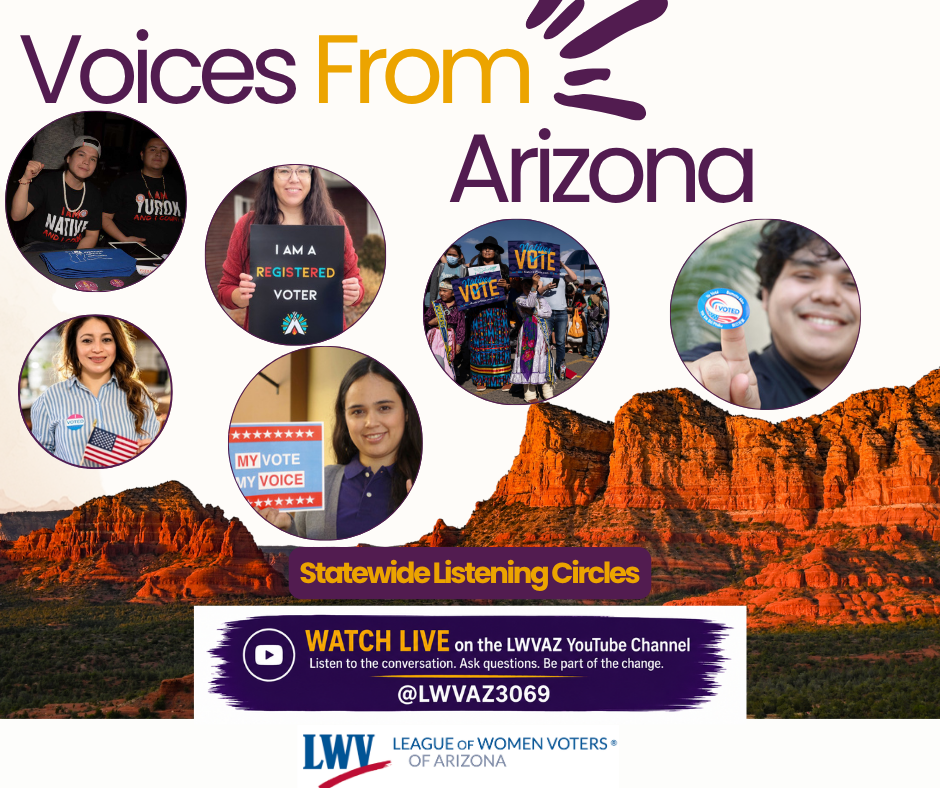
Voices from Arizona: Listening, Learning, and Elevating Community Voices
On August 8, the League of Women Voters of Arizona (LWVAZ) brought together League members, community leaders, organizers, and members of Arizona’s Latino and Native communities for Voices from Arizona Listening Circles, a statewide event commemorating the Voting Rights Act of 1965 and elevating the lived experiences of voters in communities that continue to encounter barriers to full civic participation.
More than 70 people gathered at the Phoenix Anchor Site at the George Washington Carver Museum and Cultural Center. The League of Women Voters of Metropolitan Phoenix served as the local host League for the Anchor Site, helping welcome participants and support the event. Serving as Mistress of Ceremonies was Betsy Boggia, President Emerita of the League of Women Voters of Southern Arizona. Betsy guided participants through the day’s program, introducing the Listening Circles, facilitators, and speakers and helping connect the different elements of the statewide event. Kara Pelletier, President of LWV of Metropolitan Phoenix, opened the gathering with a warm welcome to the storytellers, facilitators, community partners, League members, and guests who had come together for the day.
To extend the conversation beyond Phoenix, two additional LWVAZ local Leagues organized satellite gatherings. The League of Women Voters of Northwest Maricopa County hosted a satellite site in Surprise, and the League of Women Voters of Southern Arizona hosted a satellite site in Tucson. More than 40 people participated through the two satellite gatherings, while hundreds more connected through the statewide YouTube livestream.
A Different Kind of Conversation
Voices from Arizona was intentionally designed not as a conference or traditional panel discussion, but as a series of community Listening Circles.
The Phoenix Anchor Site hosted two distinct conversations during the day—Latino Voices and Native Voices. Each was built around a Central Circle of invited storytellers, including community members, organizers, advocates, and leaders who could speak from their own lived experiences and from their work within their communities.
Surrounding the Central Circle were community members who came not simply as an audience, but as community listeners. Their role was to hear the stories and experiences being shared, reflect on what they were hearing, and then become part of the conversation themselves.
Facilitators guided the Central Circle through conversations about:
-
How barriers to voting and civic participation have changed across generations
-
Voter registration, identification, and documentation
-
Access to the ballot and the practical experience of casting a vote
-
Transportation, geography, language, trusted election information, and other barriers
-
Community-driven solutions for strengthening voting rights and civic participation
Following the Central Circle discussions, the conversation expanded to include the community listeners. Through the statewide production, attendees gathered at the satellite sites in Surprise and Tucson could also contribute questions, comments, and experiences during the audience participation portions of the program. The goal was to connect communities across Arizona into a broader statewide conversation rather than limit the discussion to those able to travel to Phoenix.
Hearing What We May Not Otherwise Hear
The Listening Circle format allowed the conversation to go beyond policies and statistics and focus on what voting barriers actually look like in people's lives.
Attendees reflected on how valuable it was to hear firsthand about the very different voting experiences and barriers faced by Latino and Native communities.
For many, the Native Voices conversation provided a deeper understanding of the complexities Tribal voters can encounter, including navigating parallel state and Tribal elections with different rules, timelines, and locations; challenges involving physical and nontraditional addresses; transportation and distance; and other barriers to registering and casting a ballot.
Participants also observed that while Latino and Native communities experience distinct challenges related to documentation, access, trusted information, and the voting process itself, both conversations pointed to a common need: communities most directly affected by voting policies need greater representation and a stronger voice in shaping those policies.
One particularly thought-provoking question raised during the Native Voices conversation was: Why did it take until the last election cycle for an Arizona governor to visit all 22 Tribes?
The question underscored a larger theme that emerged from the day: Tribal communities should not be an afterthought during election season. Their voices, experiences, and leadership need to be part of Arizona’s ongoing conversations about voting, civic participation, and the policies that affect their communities.
Attendees also came away encouraged by the energy and commitment of storytellers in both Listening Circles to strengthen civic engagement within their communities.
From Barriers to Solutions
Importantly, the Listening Circles did not end with a discussion of barriers. Each conversation concluded by asking participants to look forward: What is already working within their communities? What needs to change? What resources and investments would make a difference? And who needs to be at the table when solutions are developed?
Arizona Secretary of State Adrian Fontes also joined the gathering and spoke about the successes and continuing challenges of election administration in Arizona.
The conversations reinforced something fundamental to the League's work: we cannot fully understand barriers to voting solely through legislation, data, reports, or policy discussions. We also have to be in community and listen to the people experiencing those barriers.
That means building relationships, creating spaces where people can tell their own stories in their own voices, and then carrying what we learn into our voter education, civic engagement, and advocacy.
Every League Member Can Listen
The conversations did not end on August 8. The edited Latino Voices and Native Voices Listening Circle recordings are now available, giving every League member an opportunity to hear directly from the storytellers and experience these remarkable conversations for themselves. The August 8 conversations were not an endpoint. They give LWVAZ and our local Leagues a stronger foundation for continuing to protect voting rights, improve access to the ballot, strengthen civic participation, and elevate voices that too often have been left out of decisions affecting their communities.
Latino Voices Listening Circle
Watch Latino Voices: https://youtu.be/rqP9H6tla0c
Facilitated by Maritza L. Félix, award-winning journalist and founder and director of Conecta Arizona, a Spanish-language news service connecting communities in Arizona and Sonora; and Elvia Díaz, longtime Arizona journalist, former editorial page editor of The Arizona Republic, and founder of NOTAS, where she provides independent analysis of Arizona and Southwest issues.
Native Voices Listening Circle
Watch Native Voices: https://youtu.be/9fHz-RwLL7c
Facilitated by Natalia Sells (Diné), Arizona Senior Campaign Manager with All Voting is Local, where her work focuses on Native voter access and county-level advocacy; and Shenise Arthur of the Phoenix Indian Center, who brings experience in community engagement, communications, and work supporting Indigenous communities.
We encourage every League member to watch one or both conversations. Listen to the storytellers themselves—the experiences they chose to share, the barriers they described, and the solutions they believe their communities need. Then help us amplify these voices. Share the recordings with friends, family, community organizations, and your own networks.
Being in a community begins with listening.
What we do with what we hear is the next step.
|
DONATE TO YOUR STATE AND LOCAL LEAGUES TO SUPPORT OUR WORK
Make a tax-deductible donation to the LWV of Arizona Education Fund—a 501(c)(3) organization—to support our civic engagement and educational programs.
LWVAZ ED FUND Your gift here directly funds state-level education initiatives Making Democracy Work.
You can also make a non-tax-deductible donation to the LWV of Arizona 501(c)(4) to support our advocacy, lobbying efforts, and actions that Empower Voters and Defend Democracy.
And don't forget to donate to your local League! Visit their website, accessible through the links on our homepage, to contribute to their community-driven efforts.
| | Copyright © 2024 LEAGUE OF WOMEN VOTERS ARIZONA, All rights reserved. | |